Is an inguinal hernia dangerous? Risks for men and women
Is an inguinal hernia dangerous? In the vast majority of cases, no—at least not immediately. Inguinal hernias develop slowly, cause hardly any symptoms at first, and surgery can be planned without rush.
An inguinal hernia only becomes dangerous when tissue becomes trapped in the hernia opening. From that moment on, hours count instead of weeks.

Medically tested by:
Dr. Hamidreza Mahoozi, FEBTS, FCCP, F.Z. Phlebologie
Updated:
July 28, 2026
Key answers at a glance:
- An inguinal hernia is usually not an emergency—but it never heals on its own
- It becomes dangerous if there is entrapment: sudden severe pain, and the bulge can no longer be pushed back in
- The risk of entrapment is low per year, but adds up over the years
- Women require special attention—there may be a femoral hernia behind it, which carries a higher risk
Read on to learn how to reliably recognize entrapment, why the risk is different in women, and when you should stop waiting.
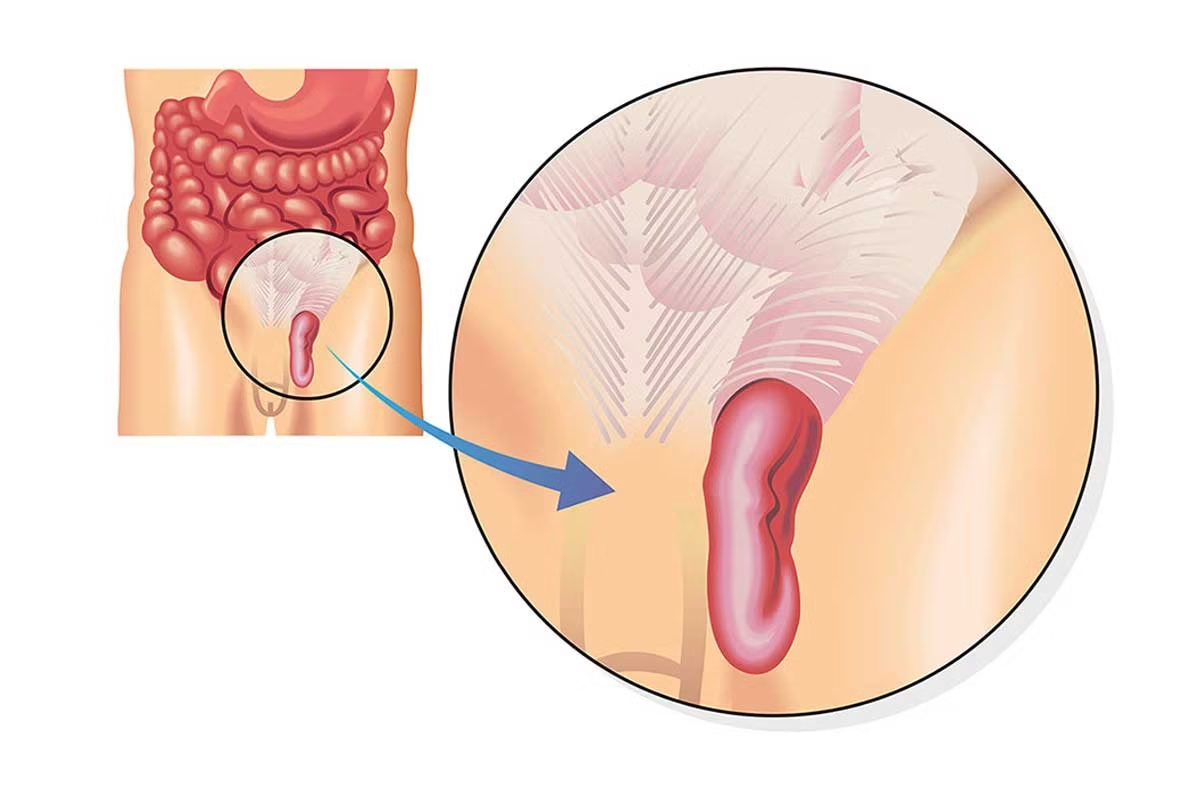
With an inguinal hernia, tissue—usually peritoneum or a loop of intestine—protrudes through a weak point in the abdominal wall in the inguinal canal (canalis inguinalis). You can read in detail about how an inguinal hernia develops, which symptoms are typical, and how the diagnosis is made under Symptoms and diagnosis of an inguinal hernia.
How dangerous is a hernia? Risks of non-treatment
An inguinal hernia does not go away on its own. The gap in the abdominal wall (hernia orifice) cannot close spontaneously.
On the contrary: pressure from inside—such as when coughing, lifting, or straining—usually makes it larger over time. Symptoms typically increase as well. A later procedure is more complex than it would have been at an earlier stage.
Entrapment—the real emergency
The real danger comes from entrapment (medically incarceration). In this case, tissue—usually a loop of intestine—slips into the hernia sac and can no longer be pushed back.
The hernia opening constricts the tissue and cuts off the blood supply. If left untreated, the trapped section of bowel can die. This is a surgical emergency that must be treated within a few hours.
Why waiting is a risk with compound interest
Statistically, entrapment is rare. The key point, however, is that this risk accumulates over the years: the longer a hernia exists, the greater the likelihood that it will happen at some point.
There is also a second point: emergency surgery is generally riskier than a planned procedure. It is performed without preparation; in some cases, bowel tissue may need to be removed, and recovery takes longer.
So the question is less whether an inguinal hernia is dangerous in principle, and more when it becomes dangerous—and whether you want to wait for that point. Current recommendations can be found in the guidelines of the German Hernia Society.
Risk of entrapment: Why women are affected differently than men
An inguinal hernia is considered a men’s problem—and statistically, that’s not wrong. Over their lifetime, men have about a 27% chance of developing an inguinal hernia, while women have only about 3%.
Why anatomy makes the difference
The reason lies in the structure of the groin region. In men, the spermatic cord passes through the inguinal canal and leaves a natural weak point there that remains for life.
In women, only the round ligament (ligamentum teres uteri) runs through the much narrower canal. A hernia sac has less room here.
Femoral hernia—the real danger in women
However, something else is crucial for risk assessment. Women more often develop a femoral hernia (femoral hernia) in the groin region than a true inguinal hernia.
A femoral hernia sits lower, below the inguinal ligament, and often causes no visible bulge. Instead, it is noticeable through pain. That’s why it is more often overlooked or initially mistaken for something else, such as a swollen lymph node.
This matters because femoral hernias become trapped far more often than inguinal hernias. According to available data, up to 30% of all femoral hernias develop incarceration, and a significant proportion of affected women require emergency surgery. The IQWiG provides a patient-friendly overview.
What this means for the recommendation
This results in a different approach. In a man with a small, symptom-free inguinal hernia, controlled watchful waiting under medical supervision may be acceptable in certain cases.
For women, on the other hand, we generally recommend timely surgery even without symptoms—because the finding may conceal a femoral hernia. You can read about which minimally invasive procedures are suitable under Inguinal hernia surgery in Berlin.
A note on diagnosis: because symptoms in women are less clear, unexplained groin pain should be specifically assessed by a hernia surgeon. An ultrasound can make a deep-seated femoral hernia visible that a palpation exam alone may miss.
Clinical notes
In female patients with unclear groin swelling or groin pain, a femoral hernia should always be considered in the differential diagnosis. Clinical examination alone is not sufficiently sensitive for this; an ultrasound of the groin region is recommended.
Due to the high incarceration rate, proven femoral hernia is generally an indication for surgery regardless of symptoms. “Watchful waiting,” which may be acceptable for asymptomatic inguinal hernias in men, is not indicated here. See the European Hernia Society guidelines.
When should you seek medical advice?
If you experience sudden, severe pain in the groin, a bulge that can no longer be pushed back in, or nausea and vomiting, you should not wait.
These can be signs of entrapment. In that case, the finding should be assessed by a doctor immediately—outside office hours, in the emergency department.
If none of these warning signs are present, there is no time pressure. An inguinal hernia that does not hurt and can be pushed back in does not need to be treated the same day.
Whether and when surgery makes sense depends on the size of the hernia, your symptoms, and your life situation. We answer this question in detail under Does an inguinal hernia always need surgery?
If you’re unsure how urgent your finding is, we can clarify it in a personal consultation. Our hernia center in Berlin-Kreuzberg (Charlottenstraße) will advise you in the hernia clinic—book an appointment.
Frequently asked questions: When is an inguinal hernia dangerous?
How do I recognize entrapment?
By sudden, severe pain in the groin or lower abdomen, often together with nausea or vomiting.
The bulge is usually hard, tender to pressure, and can no longer be pushed back in. The skin over it may be red and warm. With this combination, you should not wait—go to an emergency department immediately or call emergency services.
How quickly does entrapment need to be treated?
Within a few hours. The longer the blood supply to the trapped tissue is interrupted, the higher the risk that a section of bowel will be permanently damaged and have to be removed.
Is an inguinal hernia dangerous even without pain?
A symptom-free hernia is not an emergency, but it also does not go away on its own. The risk of entrapment exists regardless of whether the hernia causes symptoms, and it accumulates over the years.
Women require special attention because a femoral hernia with a higher risk of entrapment may be hidden behind it.
Can an inguinal hernia disappear on its own?
Not in adults. The gap in the abdominal wall does not close spontaneously.
Trusses or hernia belts can hold the hernia back temporarily, but they do not fix it and do not replace surgery.
Do I need to see a doctor immediately with an inguinal hernia?
Immediately only if the warning signs of entrapment listed above are present. Without these signs, there is no acute time pressure—an evaluation within the next few weeks makes sense to assess size and progression.
For women and children, we generally recommend a timely appointment because the risk of entrapment is higher.
How is it determined whether my inguinal hernia is dangerous?
In the hernia clinic, the groin is examined while standing and lying down, usually supplemented by an ultrasound. This allows assessment of the size, the contents of the hernia sac, and the condition of the hernia opening.
Based on this, we discuss with you whether watchful waiting is acceptable or whether surgery is recommended.
Sources
- BARMER health insurance—Health lexicon: Inguinal hernia: causes, signs and surgery. Last updated on 18.11.2024.
- Herniamed gGmbH—Patient information: 1.4.4 Inguinal hernia (Hernia register Herniamed).
- netdoktor.de—Inguinal hernia: diagnosis, treatment and prognosis.
- Gesundheitsinformation.de (IQWiG)—How is an inguinal hernia or femoral hernia treated in women?
- European Hernia Society—Guidelines for the treatment of inguinal hernias (German translation, 2018).
- VenaZiel® Hernia Center Berlin—Inguinal hernia patient guide (Retrieved 2025).