Thoracic Outlet Syndrome (TOS) is a compression syndrome at the transition from the neck to the shoulder, which can hide behind seemingly harmless symptoms such as a “dead” arm, tingling fingers, or a hand that suddenly feels heavy. Because these symptoms seem so commonplace, TOS is often only recognized late. This article explains causes, diagnosis, and treatment—from physiotherapy to surgery.
In brief:
- In thoracic outlet syndrome, nerves or blood vessels are compressed in a narrow passage between the collarbone and the first rib.
- There are three forms: neurogenic (most common), venous, and arterial (rarest, but most dangerous).
- Diagnosis is challenging because the symptoms overlap with carpal tunnel syndrome, a herniated disc, and muscle tension.
- For the common neurogenic TOS, targeted physiotherapy often helps—surgery is only necessary in certain cases.
Read on to understand which treatment makes sense when—and when you should have TOS specifically assessed by a specialist.
What exactly is thoracic outlet syndrome?

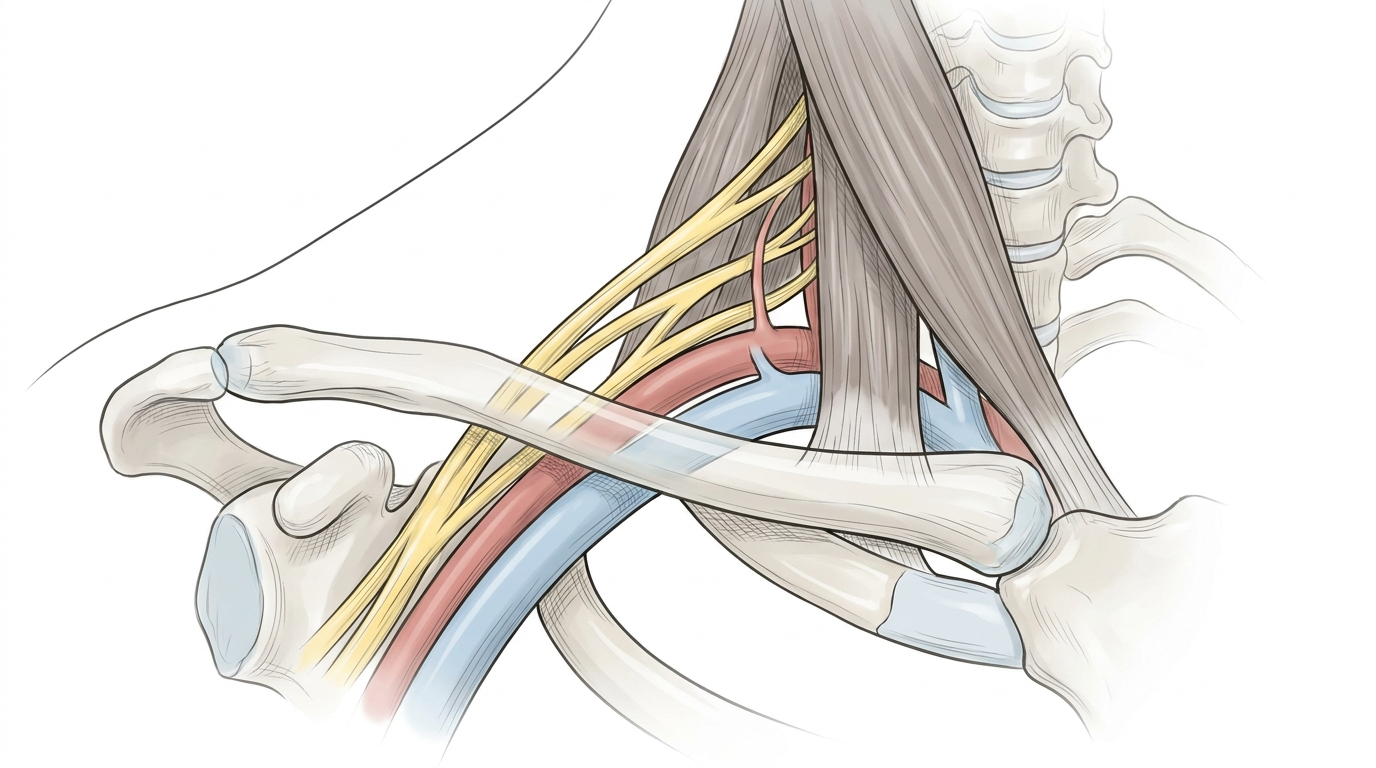
The term thoracic outlet syndrome is derived from the Latin thorax (rib cage) and the English outlet (exit, opening). It refers to the upper opening of the rib cage—a narrow anatomical passage between the collarbone, the first rib, and the surrounding muscles, especially the scalene muscles in the neck.
Several vital structures pass through this corridor from the neck into the arm: the brachial plexus (plexus brachialis), the subclavian artery (arteria subclavia), and the subclavian vein (vena subclavia).
This bottleneck is naturally already very crowded. If an additional factor makes it even narrower—such as a congenital extra rib, tense or shortened muscles, poor shoulder posture, or an injury—nerves or blood vessels come under pressure.
Depending on which structure is affected, very different symptom patterns can develop. The term “thoracic outlet syndrome” was coined as early as 1956 by the physician Peet.
To this day, TOS remains one of the most controversially discussed topics in musculoskeletal medicine—because even among specialists, the cause, diagnostics, and treatment are not always assessed consistently.
The three faces of TOS
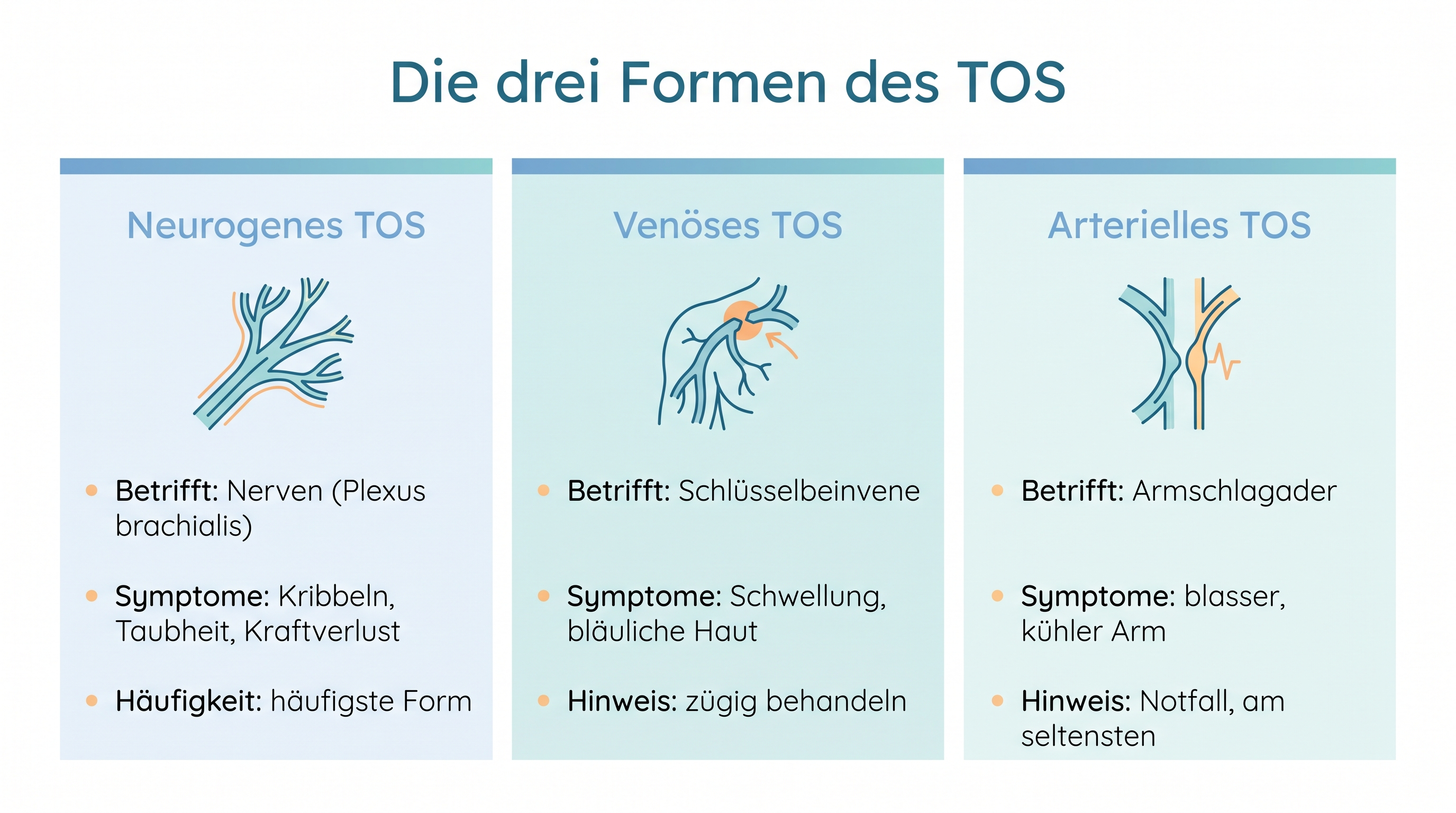
TOS is not a single condition, but an umbrella term for three very different types of compression. This distinction is crucial, because it largely determines how urgently treatment is needed and in what way.
Neurogenic TOS—the most common form by far
In neurogenic TOS, the brachial plexus is compressed. Typical symptoms include tingling, numbness, radiating pain, and unusually rapid fatigue of the arm—especially during activities above head height.
Many people also report a feeling of reduced strength when gripping or holding objects. Some describe being unable to “properly control” the arm anymore.
These limitations result from progressive irritation of the nerve pathways. They often worsen with certain head and arm positions.
Venous TOS
Here, the subclavian vein is compressed. The affected hand, arm, or even the shoulder swells visibly, and the skin may turn bluish.
In pronounced cases, the impaired blood flow can even lead to a blood clot forming in the vein. This condition is known as Paget–von Schroetter syndrome and requires prompt medical treatment.
Arterial TOS—rare, but the most dangerous form
If the artery to the arm is compressed instead, this is referred to as arterial TOS. The affected arm becomes cool and pale because blood flow decreases noticeably.
This form is the rarest, but also the most dangerous. An acute blockage of the arm artery is an emergency that, without rapid treatment, can lead to permanent functional impairment or, in the worst case, loss of the arm.
Not uncommonly, these patients also have a congenital cervical rib as the anatomical cause.
Where does TOS come from? Causes and risk factors
In many affected individuals, no single, clear cause can be identified. TOS usually arises from an interplay of several factors:
- Congenital anatomical variations: The best known is the cervical rib—an additional small rib above the first “normal” rib, originating from the seventh cervical vertebra. It may be stump-like or long and can further narrow the already tight passage.
- Muscle tension and poor posture: A forward-rounded shoulder posture, for example from hours of screen work, further narrows the passage. Shortened muscles such as the pectoralis minor (pectoralis minor) or the scalene muscles in the neck also often contribute to compression.
- Repetitive overhead movements: Sports with repetitive arm and shoulder movements—such as swimming, volleyball, baseball, or golf—have been shown to increase the risk. The same applies to jobs or hobbies that involve keeping the arms raised for long periods.
- Repeated strain from heavy loads: Regularly carrying heavy bags or backpacks on one shoulder promotes chronic irritation of the compression region.
- Injuries and accidents: Whiplash of the cervical spine is also discussed as a possible trigger. The theory: resulting instability in the upper cervical region leads to reflex shortening of the surrounding muscles to stabilize the joint—further reducing the space.
Young adults between 20 and 40 are affected strikingly often. In addition, there is a clear clustering among women between 35 and 55, without the exact reasons having been conclusively clarified.
Why diagnosis is so often delayed
TOS is one of the most frequently overlooked symptom patterns in the shoulder–arm region—and for good reason. The symptoms overlap strongly with much better-known conditions.
The most important differential diagnoses that must be reliably ruled out before a TOS diagnosis include, among others:
- a herniated disc of the cervical spine
- nerve root irritation, for example due to degenerative changes in the cervical spine
- carpal tunnel syndrome or other nerve entrapment syndromes in the arm
- muscular or orthopedic shoulder problems
This overlap has a very practical effect. In vascular surgery evaluations of patients referred with suspected TOS, a significant proportion ultimately turned out to have a different diagnosis.
So, on the one hand, thoracic outlet syndrome is a condition that is considered too rarely—on the other hand, it is also one that should not be diagnosed lightly.
Complicating matters further, symptoms are usually position-dependent. They occur especially when carrying bags, during overhead work, when lying on the side during sleep, or after prolonged sitting with shoulders rounded forward.
During a normal physical examination while seated, without targeted provocation of these positions, the symptoms often do not appear at all. That is precisely why a lot of time often passes between the first symptoms and a confirmed diagnosis.
How the diagnosis is made
Because there is no single “proof test” for thoracic outlet syndrome, diagnosis is always based on an overall picture made up of several components.
Detailed medical history and physical examination
It begins with a thorough discussion about the type of symptoms, triggers, and their course over time. This is supplemented by so-called provocation tests.
The patient deliberately adopts certain postures—for example with the arms raised and rotated backward. At the same time, it is observed whether the symptoms can be reproduced or whether blood flow changes measurably.
Imaging procedures
An X-ray reliably shows whether a cervical rib is present. Sonography (ultrasound) is becoming increasingly important because—unlike many other methods—it can be performed directly while changing the arm position, making position-dependent narrowings visible.
If vascular involvement is suspected, additional specialized vascular examinations are used. These include MR angiography or a dynamic ultrasound examination of the artery and vein in different arm positions.
Important to know: None of these examinations is absolutely conclusive on its own. Only the overall assessment of symptom description, physical findings, and imaging allows a reliable diagnosis—and at the same time safely rules out other, similar-looking conditions.

Treatment without surgery: What physiotherapy can really achieve
For neurogenic TOS—the most common form—conservative treatment is almost always the first step. The goal is to relieve the bottleneck through targeted training and improved posture, rather than eliminating it surgically.
A well-designed physiotherapy program typically includes:
- Posture and movement training for everyday life and work, such as opening up the chest, correcting shoulder position and head posture, and adapting the workstation or sports technique
- Strengthening of the neck muscles, the shoulder blade stabilizers, and the back muscles
- Stretching of shortened structures, especially the chest and scalene muscles
- Breathing and relaxation techniques to further relieve the compression region
In a considerable proportion of patients with neurogenic TOS, this approach already leads to a significant and lasting reduction in symptoms.
In addition, anti-inflammatory medication or muscle relaxants may be used temporarily. They help bridge acute pain phases and make active participation in physiotherapy easier.
However, one limitation is important. If the compression is already severe or has been present for a very long time, physiotherapy reaches its limits. The prospects of success are significantly better for purely muscular, posture-dependent symptoms than for already advanced nerve irritation.
When surgery becomes necessary
Surgical treatment of TOS is considered demanding among specialists. It is therefore generally only recommended once conservative measures have been exhausted over a sufficient period—or if it is clear from the outset that physiotherapy alone will not be enough.
This applies mainly to two situations.
In arterial TOS, surgery is practically always necessary. An acute blockage of the arm artery is an emergency that must be treated immediately to prevent permanent damage or loss of the arm. If there is already an aneurysm (bulging) of the subclavian artery, it must be treated in the same procedure with a vascular graft or a covered stent.
In venous TOS, an existing blood clot is first dissolved—for example using a special catheter inserted via the crook of the elbow with clot-dissolving medication. Afterwards, surgical removal of the bottleneck is usually also recommended to prevent the thrombosis from recurring.
In neurogenic TOS, the decision is more individualized. Surgery may be considered if physiotherapy carried out consistently over months has not led to sufficient improvement, or if symptoms progress despite treatment.
What actually happens during surgery
The goal of any TOS surgery—often referred to as thoracic outlet decompression—is to sustainably widen the narrowed passage. Depending on the underlying cause and the surgical approach, different techniques are used.
Most commonly, the first rib or an additional cervical rib is partially or completely removed. This is often combined with targeted release of constricting muscle portions, such as the scalene muscles. If vascular damage is already present, the affected vessel segment is repaired in the same procedure using an autologous or synthetic graft.
Which approach and which combination of measures makes sense in an individual case depends largely on which structure is affected, how pronounced the anatomical narrowing is, and the specific condition of the vessels and nerves.
Reliable, large-scale success statistics are only available to a limited extent for this comparatively rare procedure. Therefore, in addition to the specialist literature, treating surgeons rely heavily on their own operative experience.
A detailed, trusting conversation between the patient and the surgeon is therefore a fixed and indispensable part of treatment planning. Ultimately, the choice of procedure always remains a shared, individualized decision based on clinical judgment.
TOS in comparison: Why mix-ups happen so easily
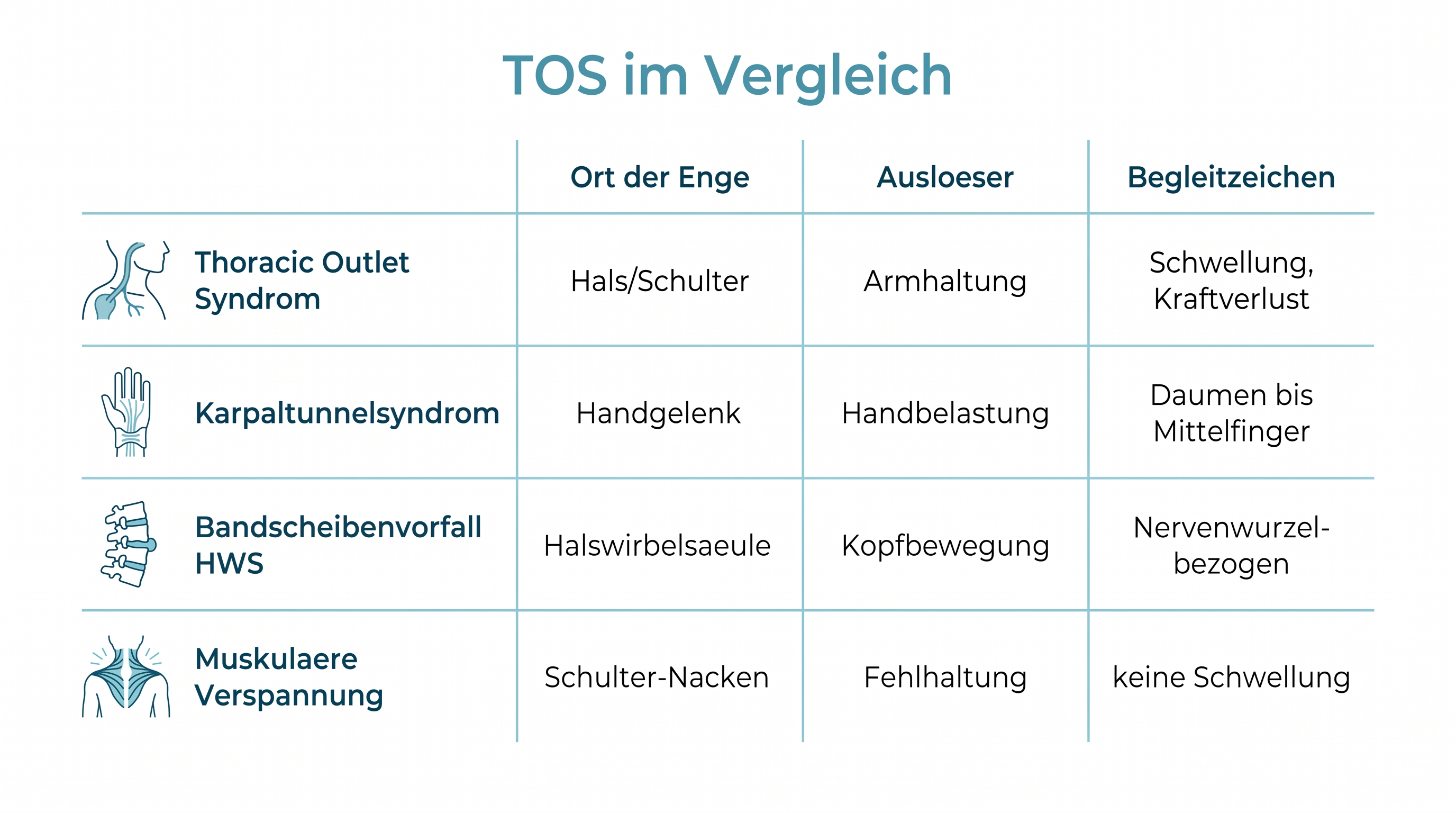
A look at the overlaps with other conditions makes it clear why even experienced physicians sometimes initially think in a different direction when it comes to TOS.
In carpal tunnel syndrome, the compression occurs at the wrist, not at the transition from neck to shoulder. Symptoms typically affect mainly the thumb, index, and middle fingers, whereas in neurogenic TOS the ulnar side of the hand is more often affected—a subtle but diagnostically important difference.
With a herniated disc of the cervical spine, symptoms also radiate into the arm. However, they are usually more clearly attributable to a specific nerve root and typically worsen with head movements or certain neck positions, rather than with arm postures.
Even ordinary muscle tension in the shoulder–neck area can initially be difficult to distinguish from early TOS. The difference: as a rule, it is not accompanied by swelling, skin discoloration, or true loss of strength.
These overlaps are the real reason why careful, multi-step diagnostics are so important. Only by ruling out other causes—and with targeted provocation tests that reproduce the individual symptom situation—can it ultimately be determined reliably whether thoracic outlet syndrome is actually present.
TOS in everyday life: What those affected can do themselves
In addition to medical and physiotherapy treatment, a few everyday adjustments can help relieve the compression region and slow the progression of symptoms:
- Check workplace ergonomics: Adjust screen height, keyboard, and mouse position so that the shoulders remain relaxed and are not pulled forward.
- Alternate carrying heavy bags and backpacks or switch entirely to carrying methods that distribute weight on both sides to avoid one-sided long-term strain.
- Build in regular movement breaks, especially during activities with raised arms or prolonged sitting.
- Rethink your sleeping position: If you notice that symptoms worsen after lying on your side on the affected shoulder, changing your sleeping posture can often provide noticeable relief.
These measures do not replace professional treatment, but they can be a useful addition—especially in early stages that are still predominantly muscular in origin.
Recovery and follow-up care
After surgery, accompanying physiotherapy usually begins promptly. Its goal is to restore shoulder and arm function and minimize the risk of symptoms recurring.
The same applies here: active participation makes a noticeable difference. Those who consistently perform the prescribed exercises and maintain the posture correction learned in everyday life secure the surgical result far better in the long term than someone who relies on the procedure alone.
For those affected who would also like to connect with other patients, there are specialized self-help and information resources on thoracic outlet syndrome. Treating clinics are happy to provide these on request.
Frequently asked questions about thoracic outlet syndrome
Is TOS dangerous?
Neurogenic TOS primarily affects quality of life, but is generally not acutely dangerous. The situation is different with arterial and, in part, venous TOS. If left untreated, circulatory disorders, blood clots, or—in rare, severe cases—tissue death in the fingers can occur. The earlier the diagnosis is made, the better the prospects for treatment.
How can I tell whether my tingling arm could be TOS?
Typical warning signs are symptoms that become significantly worse with certain arm positions—for example when holding the arms up, carrying bags, or at night while lying down. If swelling, bluish or pale skin discoloration, a feeling of coldness, or noticeable loss of strength in the arm is also present, this should be medically assessed promptly.
Does physiotherapy always help?
For neurogenic TOS caused purely by muscles or posture, the prospects of success are good. However, if nerve irritation is already advanced or if blood vessels are involved, physiotherapy reaches its limits—in many cases, there is no way around surgical treatment.
Will my health insurance cover treatment for TOS?
Diagnostic evaluation as well as conservative and surgical treatment of a medically indicated thoracic outlet syndrome are generally recognized medical services. However, the exact scope of cost coverage depends on the individual situation and insurance status (statutory or private). We will be happy to clarify the cost issue with you in advance in a personal consultation.
How long does recovery take after TOS surgery?
This depends greatly on the chosen surgical procedure, the individual findings, and overall health status. A reliable, personal estimate of hospital stay, recovery time, and return to everyday life, work, or sport is therefore always provided in an individual consultation with the treating team.
Can TOS come back after surgery?
Recurrence is generally possible, but it is not the rule. Careful follow-up care combined with accompanying physiotherapy and permanently adapted posture contributes significantly to securing the surgical result in the long term.
Can I continue to do sports with TOS?
In many cases, yes. However, especially for sports involving frequent overhead movements, technique should be reviewed and adjusted if necessary. What level of activity is appropriate in an individual case is best coordinated together with the treating physiotherapist or medical team.
Our conclusion
Thoracic outlet syndrome is rare, but is overlooked more often than average—because its symptoms resemble so many other, better-known conditions.
Anyone who repeatedly experiences tingling, numbness, or unusually rapid fatigue in the arms—especially in connection with certain postures—should keep this possibility in mind and have it specifically assessed by a specialist.
The good news: In most cases, TOS can be treated successfully—either conservatively with targeted physiotherapy or, if necessary, surgically by an experienced thoracic surgery team.
Do you recognize yourself in these descriptions, or have you already received an unclear diagnosis in the shoulder–arm area? Our team at VenaZiel in Berlin-Mitte, Charlottenstraße (Kreuzberg), and Frankfurt am Main takes the time for a thorough, individualized assessment. Book an appointment now and discuss your personal treatment options with us.

Sources and further information
- Illig KA et al.: Reporting Standards of the Society for Vascular Surgery for Thoracic Outlet Syndrome. Journal of Vascular Surgery, 2016—on diagnostics, epidemiology, and venous and arterial treatment standards. PubMed
- Peet RM et al.: Thoracic-outlet syndrome. Proceedings of the Staff Meetings of the Mayo Clinic, 1956—first description of the term.
- Independent patient information on nerve and vascular entrapment syndromes. Gesundheitsinformation.de (IQWiG)
The sources listed here are intended for professional orientation. A specific assessment of your individual case is always provided in a personal consultation with our medical team.