
The most important answers at a glance:
- An anal thrombosis is a blood clot in the superficial veins at the edge of the anus – harmless, but often very painful.
- It is not the same as hemorrhoids and cannot cause a pulmonary embolism.
- It usually heals on its own, typically within a few days to weeks.
- In cases of severe pain, a minor procedure under local anesthesia (excision) provides rapid relief.
- Anal thrombosis occurs more frequently in summer – due to prolonged sitting, heat, insufficient hydration, and cycling tours.
When a lump at the anus is harmless, when you should see a doctor, and how to prevent it – read the details here.
A stabbing pain, a tense lump at the anus – and often right in the middle of a summer vacation. Anal thrombosis is one of the most common acute proctological complaints.
In the proctology department of VenaZiel in Berlin (at Checkpoint Charlie), we see it particularly during the warm season. This guide explains in an understandable yet medically sound manner how to recognize an anal thrombosis, how it differs from hemorrhoids, which treatment is appropriate and when – and how to prevent it.
What is an anal thrombosis?
Anal thrombosis – medically correctly termed perianal thrombosis or anal vein thrombosis – is a blood clot (thrombus) in one of the small, superficial veins at the edge of the anus.
These veins lie directly under the skin and form a fine network (plexus venosus externus) that contributes to the fine sealing of the anus. If a clot blocks one of these veins, the blood congests and the vessel swells. Within hours, a visible, palpable lump develops at the anal margin.
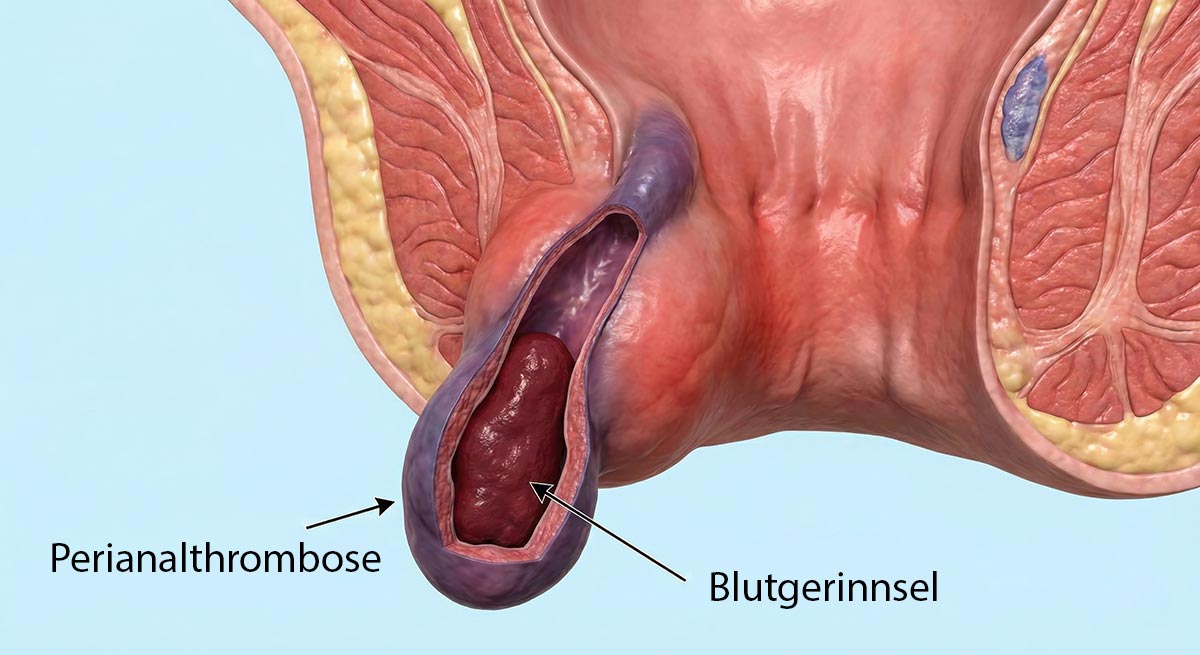
Important for reassurance: Unlike the dreaded deep vein thrombosis of the leg or pelvis, anal thrombosis occurs in superficial veins under intact skin. It cannot detach and cause a pulmonary embolism. It is therefore neither life-threatening nor a precursor to one. [Source 1]
The condition is common and is among the most frequent reasons for an acute proctological consultation. According to clinical experience, men are affected slightly more often than women, with the typical age ranging between approximately 25 and 55 years. [Source 1]
Anal thrombosis or hemorrhoids? The most important difference
Hardly any proctological topic is confused as often. In the past, anal thrombosis was incorrectly referred to as “external hemorrhoids” – this term is now outdated and medically incorrect.
The difference determines the diagnosis and treatment:
| Feature | Anal Thrombosis (Perianal Thrombosis) | Hemorrhoidal Disease |
|---|---|---|
| What is it? | Blood clot in superficial veins at the anal margin | Enlarged arteriovenous vascular cushion in the anal canal |
| Where? | Outside, directly at the anal margin – visible from the outside | Inside the anal canal; only visible externally at a late stage |
| Onset | Sudden, often “out of nowhere,” within hours | Gradual over weeks to months |
| Main symptom | Severe pain + bluish lump | Often painless, bright red bleeding |
| Color / Shape | Tense-elastic, bluish-red | Softer, skin-colored to reddish |
| Danger | Harmless, self-limiting | Harmless – but bleeding should be clarified |
Rule of thumb: Sudden, tense, bluish, and painful → likely anal thrombosis. Gradual, bleeding, rather painless → likely Hemorrhoids. The final distinction is made during the proctological examination.
Why does anal thrombosis occur more frequently in summer?
During the warm season, consultations for anal thrombosis increase noticeably. Reliable studies are lacking for many individual factors – some are based on clinical observations. Nevertheless, a consistent picture of typical summer triggers emerges:
- Hours of sitting while traveling. Long car journeys, flights, or train rides: Constant pressure on the buttocks hinders venous return – a classic trigger.
- Cycling tours and intensive sports. Prolonged cycling, unusual or pressure-intensive sports, and heavy lifting increase pressure in the anal region.
- Heat and humid-warm weather. Hot summer weather as well as sitting on cold surfaces are considered contributing factors.
- Hardened stool due to insufficient hydration. In the heat, the body loses a lot of fluid. Hard straining on the toilet is one of the most significant pressure triggers.
- Traveler’s diarrhea and dietary changes. Unusual food or diarrhea irritates the anal region; sometimes diarrhea precedes the thrombosis.
- Alcohol and spicy foods. Increased alcohol consumption on hot days is cited as a risk factor.
The good news: These very factors can be influenced – see the Prevention section.
Symptoms: How do I recognize an anal thrombosis?
The symptoms usually appear acutely. A typical description is “It came all of a sudden”:
- Sudden, stabbing, or burning pain at the anus – often instantaneous.
- One or more tense-elastic, bluish-red lumps at the anal margin, ranging from the size of a grain of rice to, rarely, several centimeters. Multiple clots in one lump are called a “multilocular” thrombosis.
- Increased pain when sitting and during bowel movements – many affected individuals can hardly sit.
- Itching, pressure, or a foreign body sensation in the anal region.
- Occasionally slight bleeding if the tense skin tears and part of the clot drains – after which the pain often subsides abruptly.
The pain is explained anatomically: The anal region is extremely densely permeated by nerve endings. Even small swellings under tension therefore trigger disproportionately severe discomfort.
Causes and risk factors
Common to all triggers is increased pressure or congestion in the perianal veins. Often a specific occasion is found, sometimes no clear cause:
- Heavy straining during bowel movements due to constipation or hard stool (most common trigger).
- Increased abdominal pressure from coughing, lifting, weight training, or playing wind instruments.
- Prolonged sitting – professionally or while traveling.
- Pregnancy and childbirth due to hormones, connective tissue changes, and increased tendency toward thrombosis.
- Other factors: Diarrhea, mechanical irritation, alcohol, and existing enlarged hemorrhoids.
Honest note on the state of research: For several of these factors, the evidence is thin. They are based predominantly on clinical experience – not every “trigger” is firmly proven.
When should you see a doctor? The red flags
An anal thrombosis is harmless and often goes away on its own. Nevertheless, a medical consultation is advisable – for pain relief and to reliably differentiate it from more serious causes.
Visit a proctological practice promptly if:
- the pain is very severe or massively restricts daily life,
- blood occurs in or on the stool and you are unsure where it comes from,
- the lump does not improve within a few days or keeps recurring,
- fever, increasing redness, localized heat, or pus are added,
- you are unsure whether it is really an anal thrombosis.
Particularly anal bleeding deserves attention. It is usually harmless – but it is a symptom through which colorectal diseases, up to and including colorectal cancer, can manifest. [Source 2] Specialist clarification therefore always serves to exclude such causes.
Not every lump at the anus is an anal thrombosis
As typical as the clinical picture usually is – other changes can also occur at the anal margin. A reliable identification is only possible through a proctological examination. Important distinctions:
- Anal fissure (anal tear): a painful tear in the skin of the anal canal. The pain occurs primarily during and after bowel movements, often with bright red blood on the paper.
- Perianal abscess: a collection of pus with increasing redness, heat, swelling, and sometimes fever. An abscess must be opened medically without delay.
- Skin tag (Marisca): a soft, painless skin fold at the anal margin, often the result of a previous thrombosis. It has no pathological significance.
- Enlarged hemorrhoids: develop slowly, are located in the anal canal, and are more likely to be noticed due to painless bleeding.
- Rarer causes: Genital warts (condylomas) or – very rarely – a tumor can also appear at the anus. Therefore, every unclear finding should be clarified by a specialist.
Note: A sudden tense lump with constant pain suggests anal thrombosis. Redness with fever suggests an abscess (urgent). Pain only during bowel movements suggests a fissure. In case of doubt, the examination decides.
Diagnosis: What happens at the proctologist’s?
- Anamnesis – discussion about onset, pain, bowel habits, and possible triggers.
- Inspection – the tense-bluish lump is often already clear to the naked eye.
- Careful digital-rectal examination – gentle palpation of the sphincter and rectum.
- Proctoscopy – brief endoscopy to reliably differentiate from hemorrhoids or fissures.
Clinical note: Attempts at reduction are futile – unlike prolapsed hemorrhoids, a thrombus cannot be “pushed back.” Diagnosis and therapy are based on the AWMF Guideline for Anal Thrombosis of the German Society for Coloproctology.
Treatment: conservative or minor procedure?
The central question is: How severe are the symptoms and how long have they been present? The therapy is based on this.
1. Conservative treatment (the rule)
In cases of moderate or already subsiding symptoms, the body breaks down the clot itself. The following have proven effective:
- Pain relief with anti-inflammatory agents (e.g., ibuprofen) – according to medical recommendation.
- Local measures: cooling compresses, decongestant and analgesic ointments.
- Sitz baths and gentle anal hygiene.
- Stool regulation: drink plenty of fluids, eat a high-fiber diet, use psyllium or flaxseeds if necessary.
Under this treatment, the pain often subsides significantly after just two to three days.
2. The minor procedure: Excision under local anesthesia
In cases of severe, fresh pain, a brief procedure brings the fastest relief. The choice of method is crucial:
- Excision (preferred): The entire thrombosed lump is cut out – rapid healing, usually without consequences, lower recurrence rate.
- Incision (only cutting open): Here, the clot is only squeezed out – with the risk that remnants remain and the condition recurs.
Therefore, complete excision is considered superior in modern proctology. [Source 1] The procedure is minor, can be performed on an outpatient basis, and is particularly useful in the first few days after onset.
Healing process and prognosis
Anal thrombosis is self-limiting – it heals even without intervention, usually in a few days to a few weeks, rarely months. Two courses are typical:
- The clot is slowly resorbed – the lump disappears, often without scarring.
- The tense skin tears, part of the clot drains, and the symptoms improve abruptly.
A skin tag (marisca) may remain as a “souvenir” – a harmless skin fold at the anal margin that is occasionally removed for hygienic reasons. As long as the cause persists – constipation, prolonged sitting, heavy lifting – a thrombosis can occur again.
First aid: What you can do yourself immediately
Until your doctor’s appointment – or if the symptoms are mild – you can do several things yourself to relieve the pain and support healing:
- Cooling, e.g., with a cold pack wrapped in a cloth for a few minutes – never directly on the skin.
- Relieve pressure from the seating area, for example with a seat ring or a soft cushion.
- Keep stool soft: drink plenty of fluids, eat a high-fiber diet, do not strain, do not stay on the toilet for too long.
- Clean gently: lukewarm water instead of vigorous rubbing with dry paper.
- Painkillers (e.g., ibuprofen) according to the package insert or medical recommendation and taking contraindications into account.
Important: Do not attempt to puncture or squeeze the lump yourself. This is painful, can lead to infections, and usually only removes the clot incompletely. This belongs in specialist hands.
Anal thrombosis in pregnancy
Pregnant women are particularly frequently affected. Several factors come together: Hormonal changes loosen the connective tissue and dilate the vessels, the growing child increases pressure in the pelvis, constipation occurs more often, and the tendency toward thrombosis is generally increased. Anal thrombosis can also occur during and shortly after childbirth due to straining.
The good news: Even in pregnancy, anal thrombosis is harmless and usually regresses on its own. The focus is on gentle, conservative measures – cooling, stool regulation, sitz baths, and pressure-relieving sitting.
Which ointments or painkillers are suitable should always be medically coordinated during pregnancy. A surgical procedure is only rarely necessary and only in cases of very severe symptoms.
Prevention: How to lower your risk – especially in summer
- Drink enough fluids – keeps the stool soft and prevents hard straining.
- Eat a high-fiber diet – vegetables, fruit, whole grains, psyllium or flaxseeds if necessary.
- Interrupt prolonged sitting – take breaks on vacation trips, stand up during flights.
- Avoid heavy straining – an elevated foot position on a stool improves posture during bowel movements and facilitates evacuation.
- Gentle anal hygiene – soft paper, additionally water, no aggressive rubbing.
- Moderation with alcohol and spicy foods – especially on hot days.
Frequently asked questions (FAQ)
Is an anal thrombosis dangerous?
No. It is very painful but harmless. Since it is located in superficial veins under intact skin, it cannot detach and cause a pulmonary embolism – an important difference from deep vein thrombosis.
Does an anal thrombosis go away on its own?
Yes, usually. The body breaks down the clot within days to weeks. However, in cases of severe pain, you do not have to endure this time – treatment accelerates relief.
Anal thrombosis or hemorrhoids – how do I distinguish between them?
Anal thrombosis comes on suddenly, is visibly located on the outside of the anal margin, is bluish, and very painful. Hemorrhoids develop slowly, are located in the anal canal, and are often noticed due to painless, bright red bleeding.
What helps quickly against the pain?
Cooling, anti-inflammatory and analgesic ointments, sitz baths, soft stool regulation and – according to medical recommendation – painkillers such as ibuprofen. For severe, fresh symptoms, excision under local anesthesia is the fastest solution.
How long does it take to heal?
Usually one to two weeks, rarely longer. After an excision, pain relief usually occurs immediately.
Do I need to be ashamed of the doctor’s visit?
No. Complaints at the anus are among the most common reasons for a proctological visit. We handle them professionally, discreetly, and routinely.
Conclusion
A sudden, painful lump at the anus is almost always an anal thrombosis – a harmless but unpleasant blood clot in the veins at the anal margin, which is often confused with hemorrhoids.
It usually heals on its own; in cases of severe pain, a minor procedure provides rapid relief. Especially in summer, it is worth keeping an eye on the typical triggers – and having any uncertainties clarified by a specialist.
Proctology at VenaZiel in Berlin
In our Center for Proctology at VenaZiel in Berlin (Charlottenstraße 13, 10969 Berlin-Kreuzberg – directly at Checkpoint Charlie, between Mitte and Kreuzberg), we treat anal thromboses discreetly, gently, and according to the latest professional standards – from conservative therapy to outpatient excision under local anesthesia. We also provide prompt care for acute, very painful findings.
Have you noticed a sudden, painful lump at the anus? Schedule an appointment in our proctological consultation hours in Berlin-Kreuzberg – we take your concerns seriously and help you find rapid relief.
Sources
[Source 1] AWMF S1 Guideline “Anal Thrombosis” (Perianal Vein Thrombosis), German Society for Coloproctology (DGK) – awmf.org. Basis for epidemiology, pathophysiology, exclusion of pulmonary embolism, and comparison of excision and incision.
[Source 2] AWMF S3 Guideline “Colorectal Carcinoma” – awmf.org; supplementary Cancer Information Service / Robert Koch Institute (rki.de) on rectal bleeding as a warning symptom requiring clarification.
Further information understandable for patients: Gesundheitsinformation.de (IQWiG) and the European Society of Coloproctology (ESCP).
Medical note: This article is for general information purposes and does not replace medical advice, diagnosis, or treatment. In case of persistent symptoms, bleeding, or uncertainty, please contact a medical or proctological practice.