Lipedema and Varicose Veins: Why the Vein Check Comes Before Liposuction
Lipedema and varicose veins often occur together. Why the vein check comes before liposuction and what it involves.
Medically tested by:
Dr. Hamidreza Mahoozi, FEBTS, FCCP, F.Z. Phlebologie
Updated:
November 2, 2026
Many women with lipedema have traveled a long road before deciding on liposuction: diets, exercise, compression, and lymphatic drainage, often combined with the feeling of not being taken seriously. When the surgery date is finally in sight, it is worth looking at something that lies beneath the fatty tissue: the leg veins. This is because lipedema and varicose veins often occur together, and a vein check before liposuction determines whether the veins are healthy.
Briefly summarized:
- Liposuction takes place exactly in the tissue layer where the great saphenous vein (Vena saphena magna) and other superficial veins run.
- When lipedema and varicose veins are present simultaneously, the starting point is different: pathologically dilated veins increase the risk of bleeding, thrombosis, and embolism.
- The vein check is essentially a painless ultrasound examination (duplex sonography) lasting about 20 to 30 minutes.
- If a diseased trunk vein is closed in advance, for example with the VenaSeal™ vein glue, the risk decreases and the tissue usually heals more evenly.
Read on to find out why VenaZiel follows the principle: first assess and treat the veins, then perform liposuction.
What happens in the tissue during liposuction
In modern liposuction, the subcutaneous fatty tissue is first saturated with a diluted anesthetic solution (tumescent local anesthesia). The tissue swells, the fat cells loosen more easily, and the blood vessels constrict due to the added adrenaline. The surgeon then inserts thin, blunt cannulas through small skin incisions and suctions out the loosened fat. Depending on the procedure, this is done using water-jet assisted (WAL), power-assisted (PAL), or traditional methods.
As gentle as the technology is today: the cannula moves without direct vision. It passes through a layer containing not only fat cells but also nerves, lymphatic vessels, and superficial veins. Especially on the thighs, inner knees, and lower legs—the classic zones for lipedema liposuction—the superficial venous system runs right through the treatment area.
The Vena saphena magna: why it is particularly at risk
The Vena saphena magna (great saphenous vein) is the longest vein in the body. It runs from the inner ankle along the inside of the lower and upper thigh to the groin, where it flows into the deep femoral vein. Its entire course lies within the fatty tissue that is treated during liposuction.
A healthy, normal-caliber vein usually elastically evades the blunt cannula. In the case of trunk varicose veins (varicose disease of the main vein), the vein valves no longer close. The blood flows backward, the vein dilates and twists, and its wall changes. Such a distended vein can hardly evade the cannula and is more easily injured.
Lipedema and varicose veins: frequently together, easily confused
Venous diseases are very common. In the Bonn Vein Study of over 3,000 adults, 14.3 percent had pronounced varicosity and only 9.6 percent had completely normal veins. Women are affected more often than men.
This is particularly relevant for patients with lipedema. Lipedema and venous insufficiency cause similar symptoms: heavy, tense legs, sensitivity to pressure, and a tendency to swell. The current S2k Lipedema Guideline clarifies that lipedema itself is not an edema disease. If the legs swell in the evening or pressure indentations remain, there is often an additional cause behind it, such as venous insufficiency.
Both diseases often occur together. The guideline therefore provides for duplex sonography to clarify venous comorbidities such as varicose veins. Additionally: in cases of pronounced lipedema, the condition of the veins can hardly be assessed from the outside because the increased fatty tissue hides varicose veins.
Honest expectations are important here: vein treatment treats venous insufficiency, not lipedema. A recent, smaller study on thermal vein procedures suggests that typical lipedema symptoms do not change as a result. The goal of vein treatment is a safe starting point for liposuction.
Read more about diagnosis and stages in our post on lipedema diagnosis; our guide Lymphedema and Lipedema explains how lipedema and lymphedema differ.
Clinical Note: In advanced lipedema, clinical assessment of the venous status is limited by the increased subcutaneous fatty tissue. Color-coded duplex sonography is the leading diagnostic tool here and should be performed before any indication for liposuction on the legs is established. The differentiation between lipedema-associated symptoms and reflux-related edema formation in the context of CVI is crucial, as it determines the treatment sequence. If trunk vein reflux (VSM/VSP) is detected in the planned suction area, endovenous restoration is recommended before liposuction, rather than suctioning through the insufficient trunk vein. The findings should be documented according to CEAP and transmitted in writing to the surgeon.
Three risks that diseased veins pose during liposuction
Why is the order so important? Three medical mechanisms interact and can reinforce each other.
Injury and bleeding
A varicose vein is under increased pressure because blood flows back. If it is opened by the cannula, it bleeds more heavily and for longer than a healthy vessel. The result can be extensive bruising (hematomas), hardening, pain, and uneven contours. In rare cases, the junction with the deep venous system is affected, which may require vascular surgical treatment.
Thrombosis and pulmonary embolism
After any operation, the tendency to clot is increased, and after liposuction, patients initially move less. The Virchow’s triad explains why this becomes a problem with diseased veins. Three factors favor a blood clot:
- slowed blood flow: blood pools in dilated veins, and after surgery, restricted movement further slows the return flow;
- increased clotting tendency: every procedure activates clotting, and the tissue trauma of liposuction reinforces this effect;
- damage to the vessel wall: the cannula can injure the vein wall, more easily in an already altered vein.
Untreated trunk varicose veins bring the first factor even before the first cut; the operation provides the other two. Furthermore, superficial vein inflammation (thrombophlebitis) can spread into the deep venous system and trigger a deep vein thrombosis there, which is the immediate precursor to a pulmonary embolism.
Fat Embolism
Less well known is the fat embolism. During liposuction, fat is deliberately liquefied. If a vein is opened in the process, a connection is created between the fat-rich tissue and the bloodstream, and fat droplets can reach the pulmonary vessels via the heart. The larger and more pressure-loaded the injured vein is, the easier this path becomes. The complication is rare but well-documented in specialist literature (Kao et al., 2023).
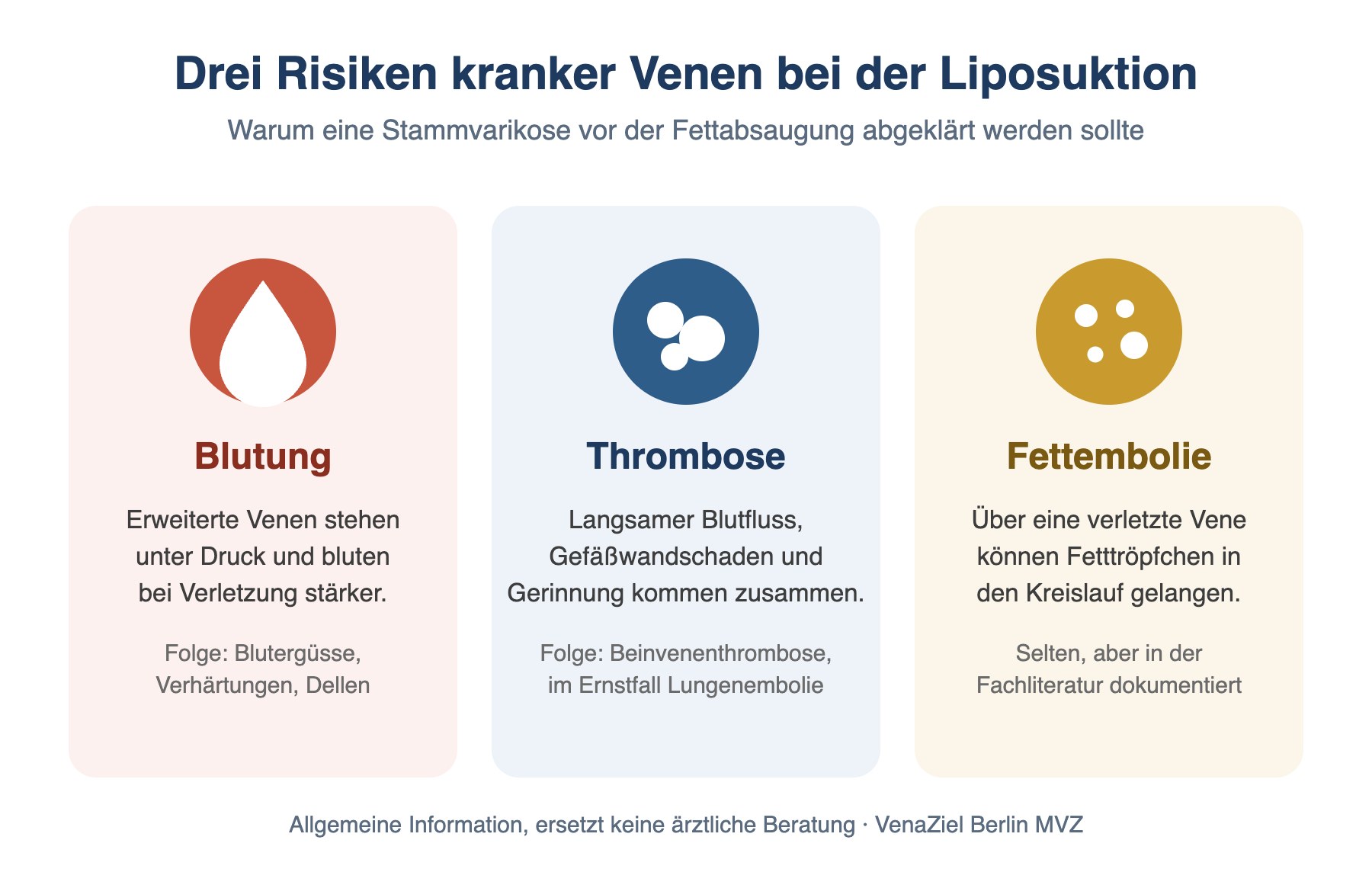
The three risks of diseased veins during liposuction: bleeding, thrombosis, and fat embolism. Graphic: VenaZiel Berlin MVZ
How common are such complications?
Liposuction is an established and generally safe procedure when correctly indicated and performed. In a large survey by Grazer and de Jong (2000) involving around 496,000 procedures, pulmonary embolism was the most common single cause of death at about 23 percent. Modern techniques and better risk management have significantly improved the situation since then: in a large US evaluation, the rate of confirmed thromboembolism after liposuction alone was 0.06 percent (Kaoutzanis et al., 2017). However, when other aesthetic procedures were combined with liposuction, the risk of confirmed thromboembolism was about 5.7 times higher than for the same procedures without liposuction.
To be honest: no randomized study has compared liposuction with and without prior varicose vein treatment. The recommendation is based on the mechanisms described, the guideline recommendation for duplex sonography, and clinical experience.
Clinical Note: The Caprini score has become established in plastic and aesthetic surgery for estimating perioperative VTE risk (validated by Pannucci et al., 2011, among others). The duplex findings provide several score-relevant data points: current varicosity, past DVT including silent post-thrombotic changes, and the immobility prognosis for large-volume procedures. Without imaging of the vein status, the assignment remains incomplete. Prophylaxis is chosen based on risk: for low risk, early mobilization and medical compression; for medium and high risk, additional intermittent pneumatic compression and, after weighing against the risk of hematoma, medicinal prophylaxis. General anticoagulation for all patients is not advisable.
The vein check: What the examination involves
At VenaZiel, the vein check before liposuction takes about 20 to 30 minutes and is painless. The focus is on color-coded duplex ultrasound, an ultrasound examination without radiation and without contrast agent that also makes the direction of blood flow visible. It is considered the gold standard in vein diagnostics (see the S2k Guideline on Varicose Veins).
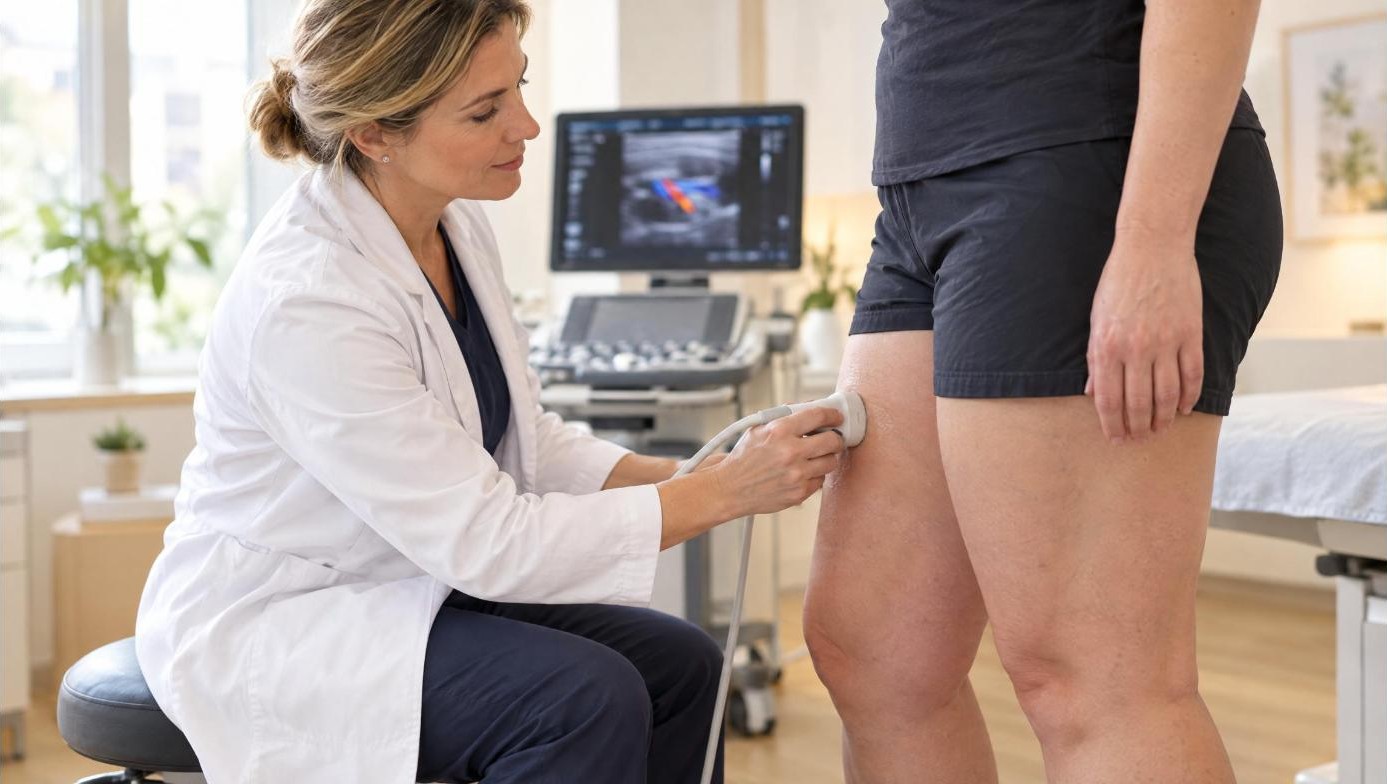
Color-coded duplex ultrasound of the leg veins while standing. Stock image (AI-generated)
The examination is performed while standing and lying down. The specialist specifically checks:
- whether the valves of the great and small saphenous veins (Vena saphena magna and parva) close;
- how far the trunk veins are dilated and where they run in the planned suction area;
- whether leaky connecting veins (perforating veins) or side branches are present;
- whether the deep venous system is clear or shows traces of an earlier, possibly unnoticed thrombosis.
In addition, we ask about previous or family history of thrombosis, clotting disorders, hormonal preparations such as the birth control pill, smoking, and previous operations. If several factors coincide or if a large-volume procedure is planned, clarification is particularly important.
The findings are classified according to the internationally standard CEAP classification. This results in one of three consequences:
- The veins are healthy: Liposuction can be planned without detour.
- Only spider veins or small veins in the skin are present: They are usually of no significance for liposuction and can be treated later if desired.
- There are trunk varicose veins or pronounced side branch varicosity: We recommend treating these first and performing liposuction after healing.
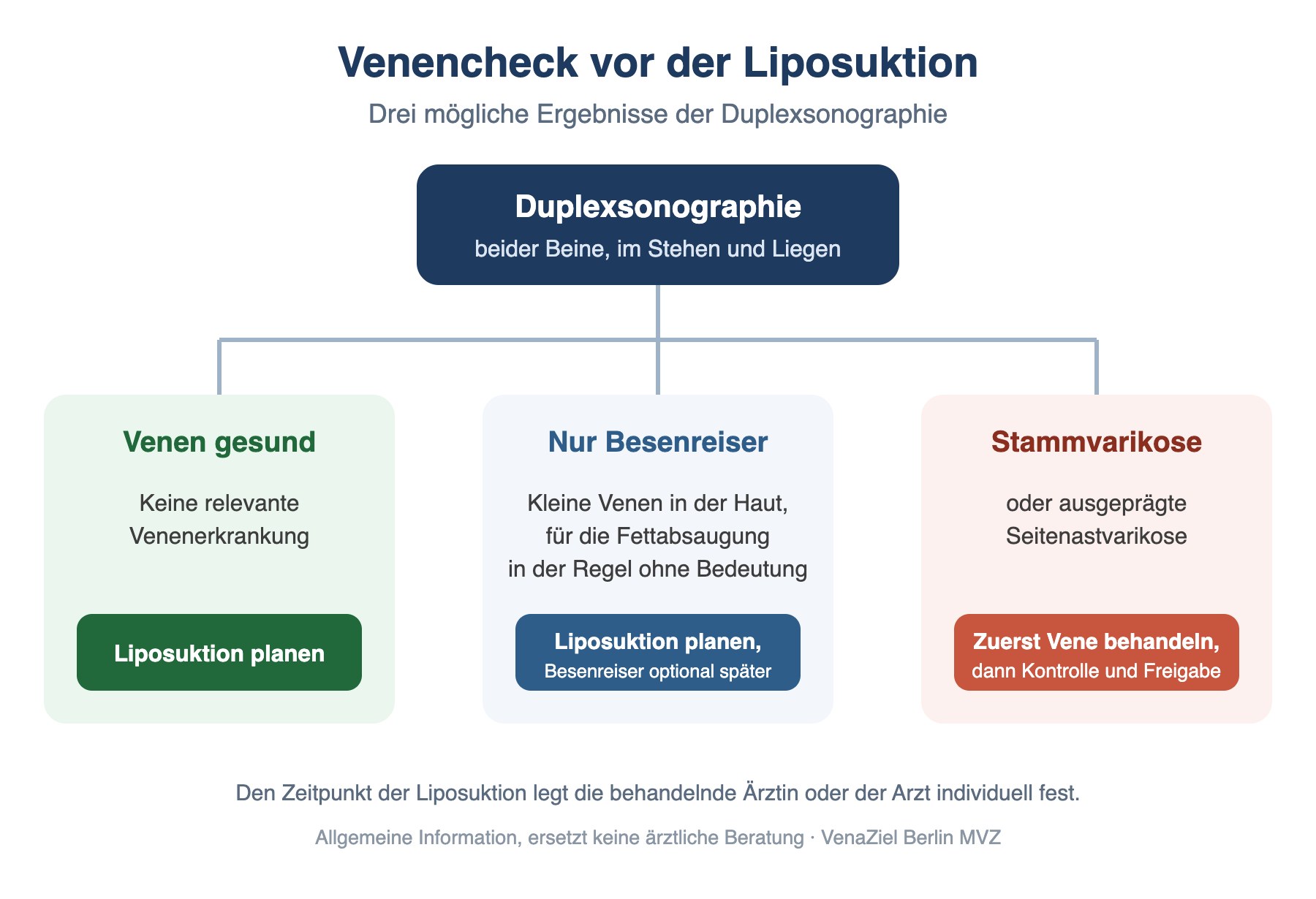
Possible results of duplex sonography before liposuction and the respective further procedure. Graphic: VenaZiel Berlin MVZ
Treating diseased veins in advance: VenaSeal™ and other procedures
Today, varicose veins rarely need to be “pulled.” Endovenous procedures, i.e., treatments from the inside via a catheter, are considered the standard: the European guideline of the ESVS recommends them as the first choice for a trunk vein requiring treatment, while the German guideline sees them as an equivalent alternative to surgery. Several methods are available at VenaZiel.
VenaSeal™ (vein glue) is the leading procedure at our vein center. The diseased trunk vein is closed via a thin catheter with a medical adhesive, without heat and without tumescent anesthesia along the vein. The treatment takes about 30 to 60 minutes, compression stockings are usually not required afterward, and most patients are back to their daily routine the following day.
For planned liposuction, this has a practical advantage: no heat damage occurs in the surrounding fatty tissue. Read more about the procedure on our page VenaSeal™ / Vein Glue.
Depending on the findings, the following may also be considered:
- Radiofrequency ablation (RFA): The vein is closed from the inside using heat via a catheter.
- Endovenous laser therapy (EVLA): same principle, the energy is delivered via a laser fiber.
- Sclerotherapy: primarily for side branches and smaller veins.
Which procedure is suitable for you is decided after the duplex sonography in a personal consultation. You can find an overview under Varicose Vein Treatments.
Clinical note: VenaSeal™ is a non-thermal, non-tumescent procedure for endovenous occlusion using cyanoacrylate adhesive. Since neither perivenous tumescence nor thermal energy is applied, thermal damage to the subcutaneous fatty tissue is avoided, which is relevant for subsequent liposuction in the same area. In the randomized VeClose study, the closure rate of the VSM after 36 months was 94.4% compared to 91.9% after RFA (Morrison et al., Phlebology 2019). In the five-year extension (Kaplan-Meier, randomized patients), it was 91.4% compared to 85.2% (Morrison et al., JVS-VL 2020), with a limited follow-up rate. In the WAVES study, the closure rate of VSM, VSP, and accessory veins up to 20 mm after twelve months was approximately 98%, without postoperative compression (Gibson et al.).
Lipedema and varicose veins: the correct order of treatment
How much time should pass between vein treatment and liposuction? There is no fixed standard interval. Your treating doctor will decide individually after the vein treatment when liposuction can take place. This is based on the ultrasound check, which confirms the secure closure of the vein, the chosen procedure, the initial findings, and how well your tissue heals.
The reverse order is unfavorable. If suction is performed first, the patient carries the full risk without benefiting from the advantages of vein treatment. In addition, scarred tissue can make later vein treatment more difficult. The result also benefits: if the source of pressure from the trunk varicosity is removed beforehand, swelling often subsides more quickly after liposuction.
Lipedema surgery as a statutory health insurance benefit: why the vein check is becoming more important now
For a long time, liposuction for lipedema was only a statutory health insurance benefit in stage III and for a limited period. In July 2025, the Federal Joint Committee (G-BA) decided to recognize it permanently in all stages; the regulation came into force on October 9, 2025. Since July 1, 2026, liposuction can also be billed as an outpatient service to statutory health insurance in stages I and II.
One prerequisite, among others, is that conservative measures have not provided sufficient relief. In addition, quality requirements apply to indication, surgical planning, and aftercare.
This means that significantly more women are likely to undergo surgery in the future. It is all the more important that the vein check is part of the standard preparation, not as an obstacle, but as a quality feature.
Your path at VenaZiel: from vein check to surgical clearance
- Initial consultation and duplex sonography: We record symptoms, history, and risk factors and examine both legs. We discuss the findings directly with you and document them in writing.
- Findings and recommendation: Without relevant varicosity, you will receive phlebological clearance for liposuction. In the case of trunk varicose veins, we will explain the treatment options to you.
- Vein treatment if necessary: The endovenous treatment is performed on an outpatient basis and takes about 30 to 60 minutes.
- Check-up and clearance: After the follow-up ultrasound, your doctor will determine the timing of the liposuction, coordinated with our Lipedema Center on Charlottenstraße (Kreuzberg) or with the surgeon of your choice.
We offer the vein check at our locations in Friedrichstraße (Berlin-Mitte), Charlottenstraße (Kreuzberg), and Frankfurt am Main. Lipedema consultations and lipedema liposuction take place in Charlottenstraße.
VenaZiel is a Medtronic observation center for the VenaSeal™ procedure: doctors from other facilities learn the method with us. In our internal quality documentation, over 15,000 endovenous procedures have been recorded to date without a pulmonary embolism occurring (as of 2026). This experience flows into every vein check but does not replace your individual risk assessment.

Medical consultation before lipedema surgery. Symbolic image
Frequently asked questions (FAQ)
Do I need a vein check even if I don’t have visible varicose veins?
Yes, that is precisely when it makes sense. Reflux in the trunk vein or a past thrombosis is often not recognizable from the outside. In lipedema, the increased fatty tissue additionally hides underlying vein problems. Only ultrasound shows the condition of your veins.
Is it really lipedema in my case, or is it the veins?
Both can cause similar symptoms, and both can be present at the same time. Duplex sonography helps to identify or rule out venous causes. We diagnose lipedema itself during the lipedema consultation based on medical history and physical examination.
Can I have vein treatment and liposuction on the same day?
We advise against this. Both procedures affect the same tissue, and the benefits of vein treatment only unfold once the vein is securely closed and the tissue has healed. Staged planning is safer and usually leads to a more even result.
Are spider veins a problem for liposuction?
Usually not. Spider veins are very superficial in the skin and are not reached by the suction cannula. However, they can be an indication of deeper trunk varicose veins, and that is exactly what duplex sonography clarifies.
Does the vein check delay my liposuction?
The examination itself takes very little time. Only if trunk varicose veins requiring treatment are present will they be closed in advance. When surgery can be performed afterward is decided individually by your doctor after the follow-up examination; there is no fixed standard interval.
Does my health insurance cover the vein check and vein treatment?
We treat patients of all insurance types. The most important cases at a glance:
- Statutory health insurance: If medically indicated, duplex sonography is a covered benefit. For vein treatment, separate agreements exist with various health insurance companies, such as Mobil Krankenkasse – VenaSeal™ for statutory patients. We will clarify beforehand whether your insurance is included.
- Privately insured or entitled to aid: Billing is based on the Scale of Fees for Physicians (GOÄ). If medically indicated, examination and treatment are usually reimbursed, depending on your tariff.
- Self-payers: You will receive a transparent cost estimate before every treatment.
Schedule a vein check now
Are you planning liposuction or lipedema surgery? Have your leg veins professionally checked beforehand: pain-free, in about 20 to 30 minutes, and with written findings for surgical planning. You can book your appointment via our appointment booking or by email to [email protected].
VenaZiel Berlin MVZ GmbH
Friedrichstraße 95, 10117 Berlin
Phone: 030 25299482
Email: [email protected]
Online appointment booking at venaziel.de
Note: This article is for general information and does not replace individual medical advice. Stated frequencies are from the cited studies; we will discuss your personal risk during the consultation.
Literature and Sources
- S2k Lipedema Guideline, AWMF Register Number 037-012 (2024).
- S2k Guideline for Diagnosis and Therapy of Varicose Veins, AWMF Register Number 037-018 (as of 2019, currently under revision).
- De Maeseneer MG, Kakkos SK, Aherne T, et al. European Society for Vascular Surgery (ESVS) 2022 Clinical Practice Guidelines on the Management of Chronic Venous Disease of the Lower Limbs. Eur J Vasc Endovasc Surg. 2022;63(2):184–267.
- Rabe E, Pannier-Fischer F, Bromen K, et al. Bonn Vein Study of the German Society of Phlebology. Phlebologie. 2003;32:1–14.
- Federal Joint Committee: Decisions of July 17, 2025, on liposuction for lipedema (Guideline on methods for outpatient medical care, Guideline on methods for hospital treatment, Quality Assurance Guideline); in force since October 9, 2025. g-ba.de/beschluesse/7335/
- Evaluation Committee, 837th meeting on June 9, 2026: Amendment of the EBM for liposuction for lipedema with effect from July 1, 2026.
- Grazer FM, de Jong RH. Fatal outcomes from liposuction: census survey of cosmetic surgeons. Plast Reconstr Surg. 2000;105(1):436–446.
- Kaoutzanis C, Gupta V, Winocour J, et al. Cosmetic Liposuction: Preoperative Risk Factors, Major Complication Rates, and Safety of Combined Procedures. Aesthet Surg J. 2017;37(6):680–694.
- Pannucci CJ et al. Validation of the Caprini risk assessment model in plastic and reconstructive surgery patients. J Am Coll Surg. 2011;212(1):105–112.
- Gloviczki P et al. The 2022 SVS/AVF/AVLS clinical practice guidelines for the management of varicose veins of the lower extremities, Part I. J Vasc Surg Venous Lymphat Disord. 2023;11(2):231–261.
- Morrison N, Kolluri R, Vasquez M, et al. Comparison of cyanoacrylate closure and radiofrequency ablation for the treatment of incompetent great saphenous veins: 36-month outcomes of the VeClose randomized controlled trial. Phlebology. 2019;34(6):380–390.
- Morrison N, Gibson K, Vasquez M, Weiss R, Jones A. Five-year extension study of patients from a randomized clinical trial (VeClose) comparing cyanoacrylate closure versus radiofrequency ablation for the treatment of incompetent great saphenous veins. J Vasc Surg Venous Lymphat Disord. 2020;8(6):978–989.
- Gibson K, Ferris B. Cyanoacrylate closure of incompetent great, small and accessory saphenous veins without the use of post-procedure compression: initial outcomes of a post-market evaluation of the VenaSeal System (the WAVES Study). Vascular. 2017;25(2):149–156; 12-month data presented at the Charing Cross Symposium 2017.
- Kao YM, Chen KT, Lee KC, et al. Pulmonary Fat Embolism Following Liposuction and Fat Grafting: A Review of Published Cases. Healthcare. 2023;11(10):1391.
- Reyes Valdivia A, Zevallos A, Fabregate Fuente M, et al. Lipedema symptoms are not influenced by endothermal ablation in patients with varicose veins. Phlebology. 2026. doi:10.1177/02683555261418968